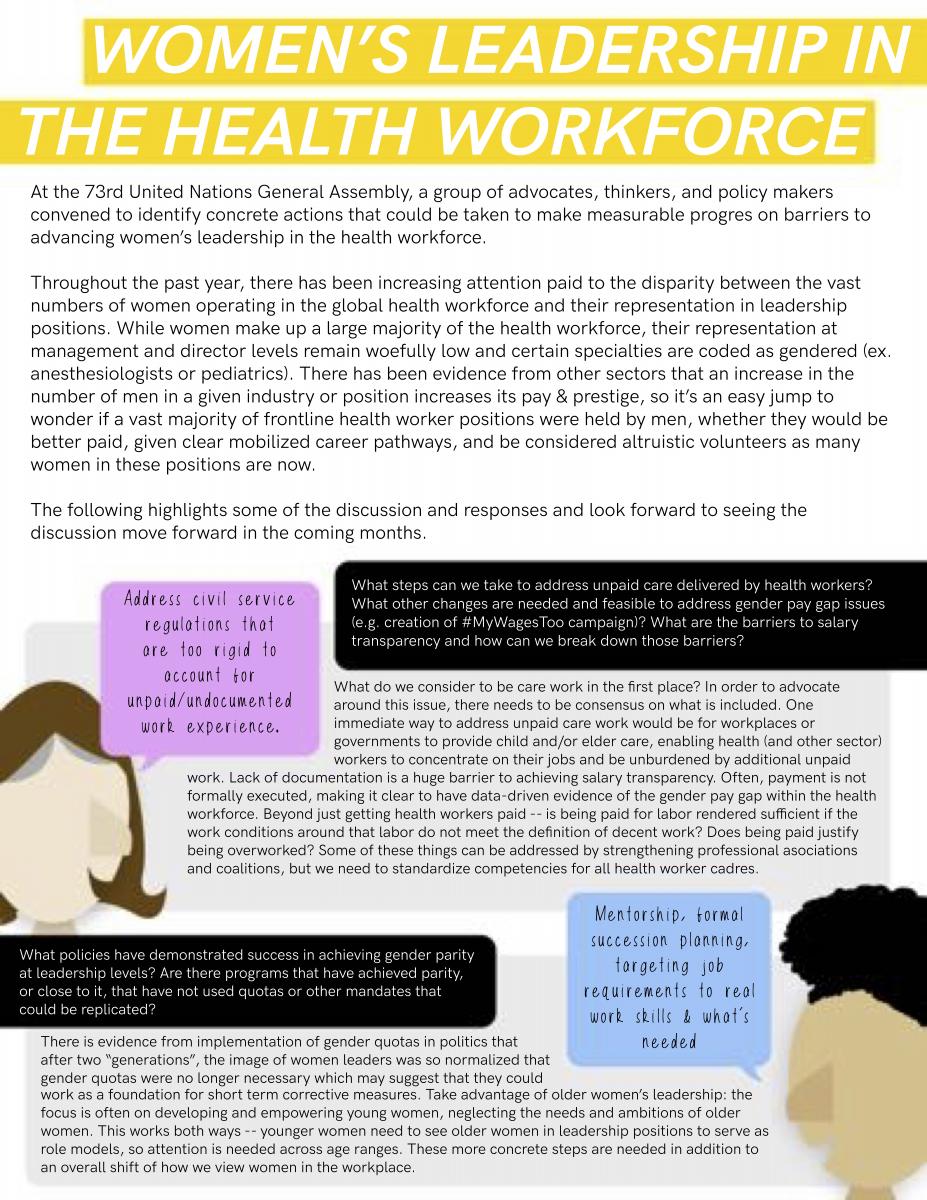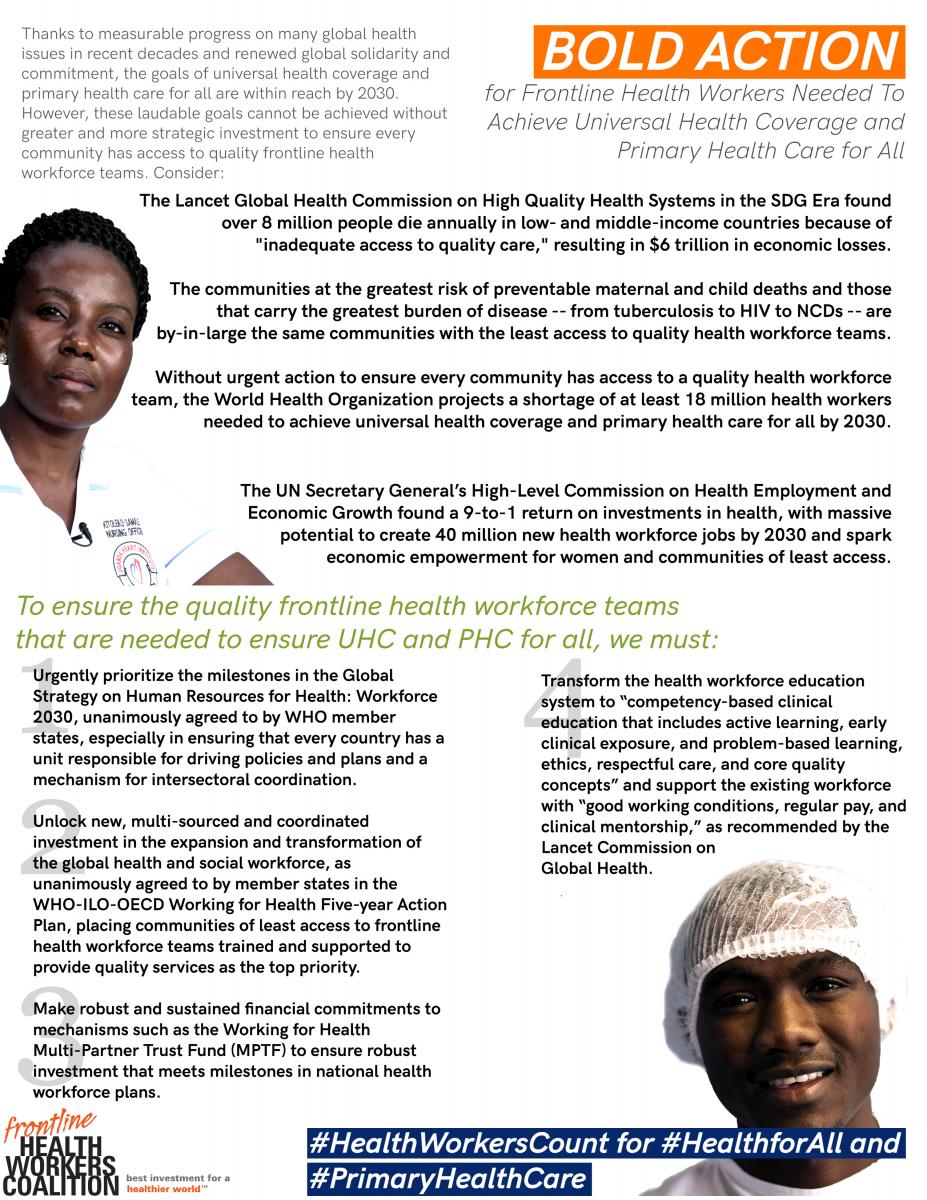
RESOURCES

Please contact us if you would like a publication or report posted. Please note that not all publications and reports will be posted.

COALITION PUBLICATIONS

OTHER PUBLICATIONS

Columbia University and the Earth Institute Health Systems 20/20
One Million Community Health Workers: Technical Task Force Report
In response to widespread recognition of the need to scale up community health workers as a part of primary health systems in Sub-Saharan Africa, this technical report was prepared to consolidate scientific and implementation experience in a series of recommendations and guidelines. Development of this report was a collaborative effort with input from scientific experts, led by the Earth Institute at Columbia University in support of the UN objectives to achieve the MDGs.
Better Health Systems Briefs 2012
The Better Health Systems briefs explore Health System’s 20/20 strategies and tools, why they work, and how they contribute to better health systems. Collectively, the series will distill valuable lessons learned in an effort to share the project’s wisdom with our partners and colleagues.
Health Systems 20/20 IntraHealth International
Why Differentiating between Health System Support and Health System Strengthening is NeededWhy differentiating between health system
support and health system strengthening
is needed

“Supporting the health system can include any activity that improves services, from distributing mosquito nets to procuring medicines. These activities improve outcomes primarily by increasing inputs. Strengthening the health system is accomplished by more comprehensive changes to performance drivers such as policies and regulations, organizational structures, and relationships across the health system to motivate changes in behavior and/or allow more effective use of resources to improve multiple health services.”
Saving Lives, Ensuring a Legacy: A Health Workforce Strategy for the Global Health Initiative
This paper underscores how the U.S. Global Health Initiative (GHI) should deal with the health workforce crisis and how U.S. government policies have yet to be translated into a coherent strategy with clear goals, resource allocation, technical approach and indicators of progress.
IntraHealth International IntraHealth International
“I’m a Health Worker”
This video series highlights how we place health workers at the center of our efforts to address the global health workforce shortage. Our staff conducted quick, informal interviews with health workers during trips to various countries. We invite you to hear their voices and learn what we’re doing to help them save even more lives.
Holding Health Workers Accountable: Governance Approaches to Reducing Absenteeism
The West African Health Organization is implementing a regional approach to strengthening health workforce information systems, leveraging resources from USAID-funded projects, donors, and global organizations. This technical brief provides an overview of this approach, highlights lessons learned, and provides recommendations for other regions and countries to adopt the approach.
IntraHealth International The Partnership for Maternal, Newborn, & Child Health
West Africa’s Regional Approach to Strengthening Health Workforce Information
Health workforce absenteeism is a serious problem and can greatly diminish the effectiveness of health service delivery. Reducing absenteeism requires a decentralized approach involving broad stakeholder groups to address underlying governance issues and reinforce complementary accountability mechanisms. This technical brief looks at the cost of absenteeism, examines governance issues, describes the various stakeholders, and offers a number of recommendations for strengthening governance to reduce absenteeism.
Background Paper for the Global Strategy for Women’s and Children’s Health: Access for all to skilled, motivated, and supported health workers
According to this report, human resources are the backbone of health systems, but if crucial human resources for health shortages are not addressed, it will not be possible to achieve the MDGs. The paper outlines the Agenda for Global Action, which envisages six interconnected strategies.
Save the Children Save the Children
Missing Midwives
This report demonstrates that midwives are critical to saving the lives of mothers and newborn babies. Filling the global shortage of 350,000 midwives must be a global priority if we are to reduce the terrible rates of maternal and child mortality in the world’s poorest countries.
State of the World’s Mothers 2010: Women on the Front Lines of Health Care
Countries must invest in women who are frontline health care workers, says Save the Children in the 2010 version of its annual State of the World’s Mothers reports. In conjunction with the release of this report, and to highlight how investments in women health workers on the frontlines can save children’s lives, the Ad Council and Save the Children launched a public service advertising campaign and companion website GoodGoes.org.
UNFPA World Health Organization
The State of World’s Midwifery 2011: Delivering Health, Saving Lives
Supported by 30 partners, this report provides a comprehensive analysis of midwifery services and issues in countries where the needs are greatest with the bottom line that a dramatic increase in midwives is needed.
Global Experience of Community Health Workers for Delivery of Health Related Millennium Development Goals: A Systematic Review, Country Case Studies, and Recommendations for Integration into National Health SystemsThis document is an assessment of the impact and effectiveness of global experience of community health workers in delivering care related to health and nutrition MDGs. There is in-depth analysis of eight country case studies in Sub-Saharan Africa (Ethiopia, Mozambique and Uganda), South East Asia (Bangladesh, Pakistan and Thailand) and Latin America (Brazil and Haiti).
World Health Organization World Health Organization
Increasing Access to Health Workers in Remote and Rural Areas Through Improved Retention
After a year-long consultative effort, the WHO compiled this detailed report which documents 16 evidence-based recommendations on how to best improve the recruitment and retention of health workers in underserved areas. Additionally, this report serves as a guide for policy makers to choose the most appropriate interventions, and to implement, monitor, and evaluate their specific impact over time.
Scaling Up, Saving Lives: Task Force for Scaling Up Education and Training for Health Workers, Global Health Workforce Alliance
The report was issued by an international group of experts in health and education at the 61st World Health Assembly and stresses the need for urgent action to address the acute shortage of health workers. Drawing on examples from 10 country studies – Bangladesh, Brazil, Ethiopia, Ghana, India, Kenya, Malawi, Pakistan, Tanzania and Venezuela – the report details a set a recommendations to ensure a sufficient increase in health workers to meet MDG targets.
World Health Organization World Health Organization
Management of Sick Children by Community Health Workers: Intervention Models and Programme Examples
This report examines approaches for the community management of sick children through the use of community health workers. The report is based on an extensive review of literature, including peer- reviewed studies, reports, program descriptions and program evaluations.
Scaling-up the Community-Based Health Workforce for Emergencies
This document is a document published by GHWA, IFRC, UNHCR, UNICEF, WHO and seeks to raise awareness about community based health workforce, promote the scale up of community based health workforce, and encourage government and partners to reinforce community-based health workers by strengthening the health systems and providing resources in support of local action to reduce health risks and manage emergencies.

VIDEOS

Shot on location in Maasailand in Kenya, Kwazulu Natal in South Africa and the Kechene Slum in Addis Ababa, Ethiopia, this documentary film tells three stories about how AMREF (African Medical Research Foundation) aims to transform lives across Africa. This video explores an AMREF trained Village Heath Team’s work in Northern Uganda. In this part of the country most of the healthcare facilities that did exist were destroyed by conflict.
This video, from Coalition member AMREF, is of Almaz Nagade, a health extension worker in Doiso, Ethiopia. Coalition member Accordia Foundation released this video profiling the Infectious Diseases Institute in Uganda.
This video, from Coalition member AMREF, is of Esther Madudu, 31, an AMREF-trained midwife employed by the Government of Uganda who works at the Atirir Health Center IV in Katine District. AMREF is trying to garner support for Esther’s nomination for a 2015 Nobel Peace Prize. Coalition member Jhpiego released this video that highlights the lack of access to cervical cancer screenings and treatment in the developing world.
Frontline Health Workers Coalition: Closer to Home focuses on the shortage of frontline health workers in the developing world. Global Health Workforce Alliance: Imagine is an animated film highlighting the health workforce crisis and focuses on “Flo”, a skilled health worker who leaves her home in search of a better life.
Partners In Health: Training for Health highlights the importance of training and mentorship of frontline health workers in developing quality health systems. Save the Children introduces people to the life-saving work of frontline health workers with this Mission video for the See Where the Good Goes campaign, developed in partnership with the Ad Council.
White Ribbon Alliance: Birth and Death and Going the Distance are two videos portraying the lack of attention to how many women still die giving birth around the world, and the need for access to trained professional care.

LINKS TO OTHER HEALTH WORKFORCE COALITIONS, ALLIANCES AND RESOURCE CENTERS

Many of our members’ websites have information on frontline health workers. Other coalitions, alliances and networks working in this area include:

CHW Central
CHW Central is an online community of practice focusing on community health worker (CHW) programs, research and policy.
Global Health Initiative Coalition
The GHI Coalition is calling on the U.S. to take an ambitious, comprehensive approach to global health policy and funding.
Global Health Workforce Alliance
GHWA was created in 2006 as a common platform for action to address the workforce crisis. The Alliance is a partnership of national governments, civil society, international agencies, finance institutions, researchers, educators and professional associations dedicated to identifying, implementing and advocating for solutions.
Health Workers Count
Health Workers Count is a global advocacy effort working together for more health workers, better supported.
Health Workforce Advocacy Initiative
HWAI engages in evidence-based advocacy to advance local, regional, and global efforts to enable all people, at the soonest feasible time, to have equitable and sustained access to a skilled, motivated, and well-equipped, informed, and managed health workforce who have decent wages and good working conditions, and are integrated into well-functioning health systems.
HRH Global Resource Center
The Human Resources for Health (HRH) Global Resource Center is a global digital library of HRH resources focused on developing countries.